

Tourism
| Number of Hotels (2013) | 1 176 |
Total capacity of hotels and:
|
98 804
|
| Nombre de nuitées dans les hôtels et établissements assimilés (2012) | 6 640 181 |
Source : NOS
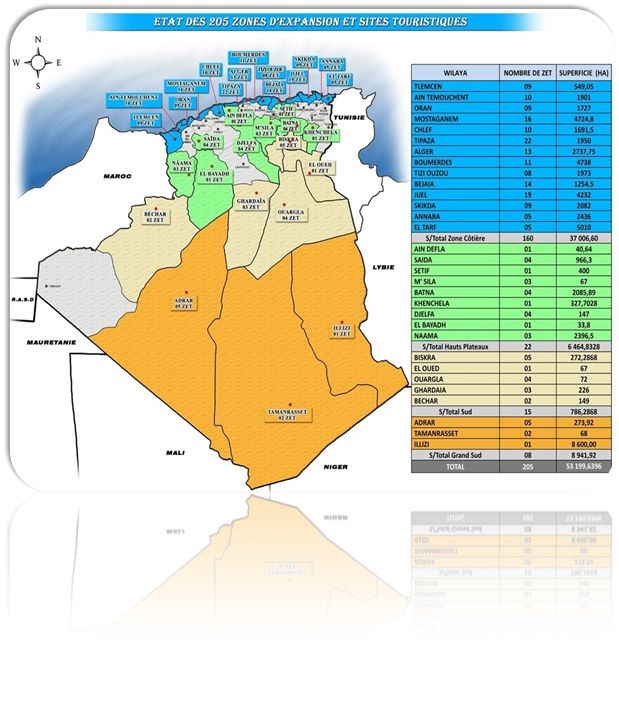
Sept sites inscrits au patrimoine mondial de l’Unesco
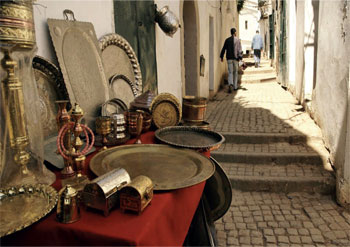 |
THE CASBAH OF ALGIERS
In 1516, the Turkish Kheir el-Din establishes his capital in Algiers. He made of it a fortified city by building imposing ramparts, which are originally from the Casbah. Six doors ensure the link between the old city, the port and the rest of the country: 1. In Southwest and at the foot of the Casbah: Bab el-Djedid; 2. In the South, Bab-Azoun; 3. In the East, Bab el-Bahr; 4. In the East, Bab el-Djezira giving access to the breakwater; 5. .In the North, Bad el-Oued. The Casbah’s surface is over 45 hectares and shows a homogenous urban form in an original and rugged site (118 m height difference). The wealth of the city is reflected in the interior of its houses, often arranged around a square central courtyard making an atrium. The winding and steep streets are also a feature of the old city. The Casbah is a UNESCO World Heritage since 1992. |
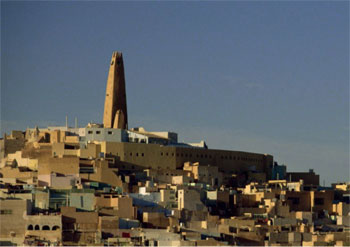 |
M’ZAB VALLEY
Located in the province of Ghardaia, 550 km south far from Algiers, the M’Zab Valley is a northern region of Sahara, declared a UNESCO World Heritage since 1982. The M’zab is a rocky plateau with altitudes ranging between 300 and 800 m. The medium altitude is 500 m (Ghardaia: 526 m). The deepest valleys, lined with rocky cliffs steep slopes, show a slope that rarely exceed 100 m above the plateau. Overall, The M’zab is a flat region. |
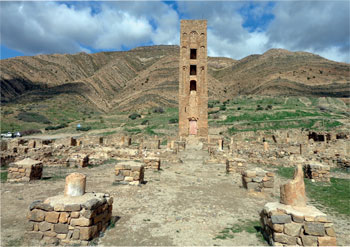 |
kalaat BENI HAMMAD
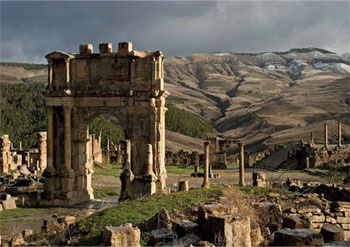
The Kalâat of BeniHammad is a remarkable archaeological site located in 36 km to the northwest of M’Sila, in the municipality of Maadid, This set of preserved ruins, at 1000 m altitude, is located in a mountainous setting of stricking beauty. The kalaat of Beni Hammad was founded in the early eleventh century by Hammad, son of Bouloughine (founder of Algiers), and abandoned in 1090 under the threat of a Hilalian invasion. It was the first capital of Hammadid emirs and enjoyed great splendour. The Kalaat comprises, 7km of partially dismantled fortified walls, a large number of monumental vestiges, among which are the mosque and its minaret, and a series of palaces. The mosque, with its prayer hall comprising 13 naves of 8 bays, is the biggest after that of Mansourah, its minaret is the oldest in Algeria after that of Sidi Boumerouane. The ruins of the Kalaat bear witness to the great refinement of the Hammad civilization, an original architecture and the palatial culture of North Africa. It is classified a UNESCO World Heritage since 1980. |
 |
DJEMILA
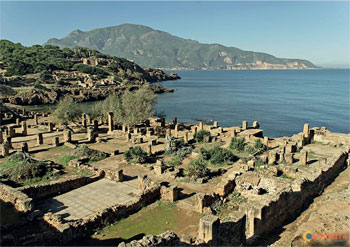
Founded in the year 98, Djemila, or Cuicul, is an ancient Roman town situated in the high plains of Eastern Setif, it is, with its forum, temples, basilicas, triumphal arches and houses, an interesting example of roman town planning adapted to a mountain location. The ruins are classified heritage of humanity by UNESCO since 1982. |
 |
TIPASA
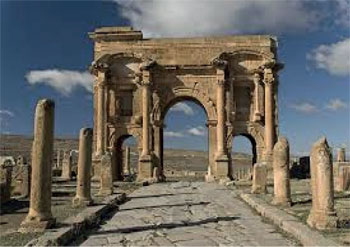
On the shores of the Mediterranean, Tipasa was first a Carthaginian trading, the necropolis is one of the oldest and most extensive of the Punic world (sixth in the second century BCE). During this period, Tipasa played the role of a maritime port of call, a place of trade with indigenous peoples. Located 60 km west of Algiers, it is a serial property comprising three sites: two archaeological parks located in the vicinity of the present urban and the Royal Mauretanian Mausoleumon the western Sahel plateau of Algiers, at 11 km south -east of Tipasa. Tipaza was then occupied by Rome and turned into a strategic base for the conquest of the kingdoms of Mauritania. It comprises a unique group of Phoenician, Roman, palaeochristian and Byzantine ruins alongside indigenous monuments such as the Kbor Roumia, the great royal mausoleum of Mauritania. The Roman period is marked by a prestigious ensemble of buildings, comprising very diversified architectural typologies. The Vandal invasion of 430 years did not mark the definitive end of prosperity of Tipasa, but the town, reconquered by the Byzantines in 531, gradually fell into decline from the VIth century The archaeological site was declared a World Heritage Site by UNESCO in 2002, and described as “one of the most extraordinary archaeological complexes of the Maghreb.” |
 |
TIMGAD
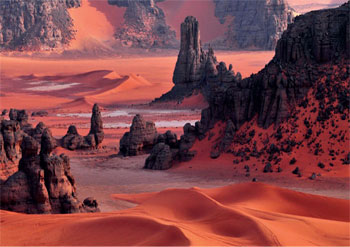
Known as the “Pompeii of the North Africa”, Timgad is an ancient city located in the province of Batna. It was founded by the Roman emperor Trajan in 100 as a military colony. This is the last deduction Roman colony in Africa. Built with temples, baths, the forum and its theatre, the city, initially with an area of 12 hectares, eventually deal over fifty. Given its excellent state of preservation and the fact that the considered typical of a Roman city, Timgad was declared World Heritage by UNESCO in 1982. |
 |
TASSILI
Tassilin’ Ajjer is a vast high arid plateau in the south-eastern Algeria made of sandstone, with more than 1 000 m and extending to central Sahara of 50 to 60 km from east to west, and 800 km from north to south, an area of almost 120,000 km². The panorama of geological |